
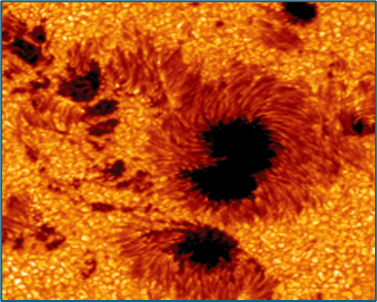
- The outer part surrounding or region is called as the Penumbra.
- The inner black part of a sunspot is known as the Umbra. It appears darker than the surroundings as its cooler than them.
What are sunspots and how are they formed?
Sunspots are temporary spots on the Sun’s surface that are darker than its surrounding area. They are caused by the Sun’s magnetic field.
When are they formed?
Just as our Earth goes through seasonal changes, our Sun goes through an 11-year solar cycle. The Sun moves from times of explosive eruptions (solar Maximum) to calm (Solar Minimum) stretches of relative silence. Sunspots are temporary, dark, cooler patches on the Sun’s photosphere (3500- 4500 kelvin) caused by intense, concentrated magnetic field flux that inhibits convection. Ranging from Earth-sized to much larger, they appear in pairs with opposite polarity and follow a roughly 11-year solar cycle.
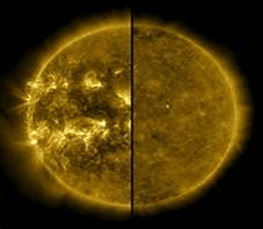
Solar max Solar min
In 2019 the sun was in its phase known as solar minimum, whereas right now we are in the period known as solar maximum- where the solar activity is at its peak! Strong Solar Flares, Coronal mass ejections and the Northern and Southern lights are most readily observed during this time.
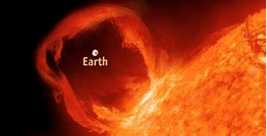
Solar flare can be several times larger than earth
These phenomena cause geomagnetic storms, which can disrupt satellites, radio communications, and electric power grids, while also creating auroras
However the Earth has it’s defenders- Van Allen belts
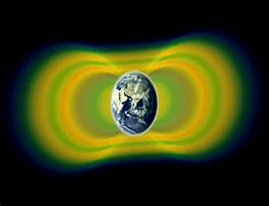
When solar material streams strike Earth’s magnetosphere, they can become trapped and held in two donut-shaped belts around the planet called the Van Allen Belts. The belts restrain the particles from traveling along Earth’s magnetic field lines, continually bouncing back and forth from pole to pole.


Leave a Reply