“Everything is made up of matter, but what is matter made up of”?
Matter makes up us and everything around us, but there are smaller things that make up matter, called as atoms. They are not visible to humans through human eye but extremely powerful microscopes can help us barely see them.
Structure of atoms:
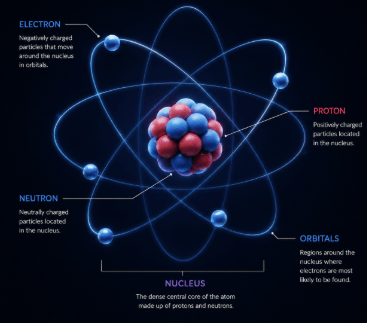
Protons: These have positive charge.
Neutrons: These have Neutral charge.
Nucleus: This is a structure at the center of the atom.
Electrons: The particles that carry negative charge and orbit the nucleus.
Orbitals: The region around the nucleus where electrons are usually found.
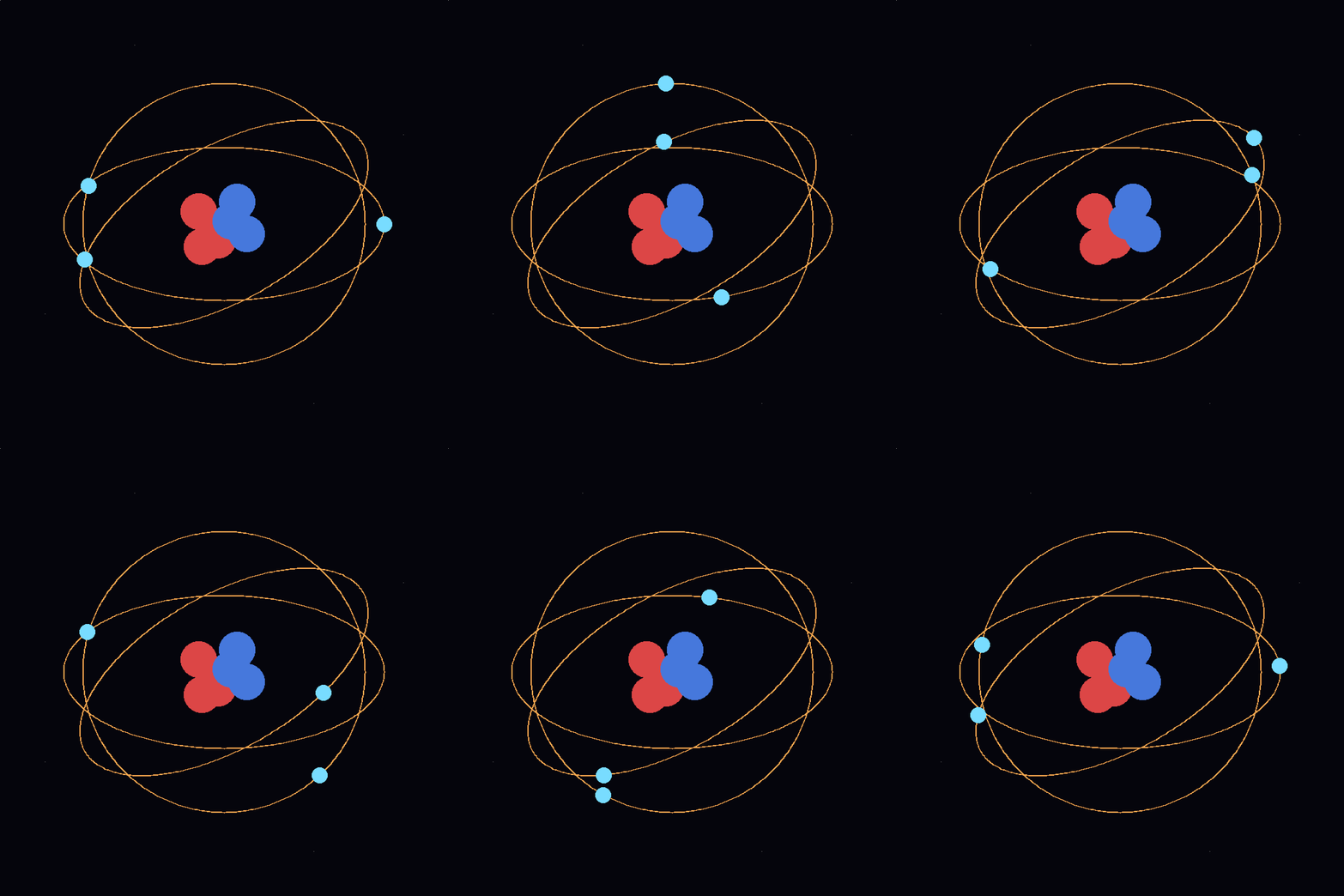
These atoms are written down in something called the periodic table. Each element of the table is unique and contains an extremely small, positively charged nucleus surrounded by a cloud of negatively charged electrons. Although the nucleus is less than one ten-thousandths of the size of the atom, the nucleus contains more than 99.9% of the mass of the atom.
According to Bohr’s Atomic model electrons revolve around the nucleus in a specific circular path known as orbit or called a shell. Shells have stationary energy levels; the energy of each shell is constant. Each stationary orbit or shell is associated with a definite amount of energy. 1st shell- K shell, 2nd shell- L shell, 3rd shell- M shell, 4th shell- N shell.
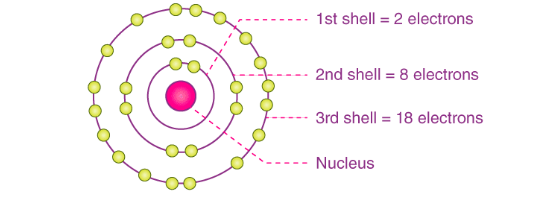
Structure of an atom nucleus in the center, electrons on each shell


Leave a Reply