A Tidal Disruption Event (TDE) is a violent cosmic phenomenon that occurs when a star passes too close to a supermassive black hole and is ripped apart by the black hole’s immense gravitational tidal forces.
Three main key Stages are involved in this event:
Spaghettification: As the star approaches the black hole, the gravitational pull on the near side of the star is vastly stronger than on the far side. This causes the star to be streched vertically and compressed horizontally, pulling it into a long thin stream of gas.
Accretion Disk: About half of the stellar debris is ejected into space, while the other half remains bound to the black hole. As the material spirals inwards, a superheated disk of matter is created.
The Flare: The friction and intense energy within the accretion disk cause a massive, luminous burst of radiation—shining brightly in X-ray, ultraviolet, and optical light. This can cause the galaxy to be outshined from months to years until the black hole gradually sucks in all the matter.
Multi-Messenger Observations
Modern astronomy does not just look at the light from a TDE; it listens to multiple “messengers” from the event. These messengers can be X-rays, neutrinos or Optical and UV light:
X-Rays: These are captured by space observatories like NASA’s Chandra X-ray Observatory. These rays can reveal how extremely hot inner accretion disk, reaching temperatures of millions of degrees.
Optical and UV: Ground-based survey systems like the Zwicky Transient Facility (ZTF) catch the initial flare in visible and ultraviolet light, mapping the cooler, expanding gas envelope surrounding the shredding site.
Neutrinos: A neutrino is a fundamental subatomic particle with no electrical charge and an extremely tiny mass. In rare, highly energetic jetted TDEs, particles are accelerated so intensely that high-energy neutrinos are ejected. Facilities like the IceCube Neutrino Observatory at the South Pole have successfully traced ghost-like neutrinos back to TDE flare coordinates billions of light-years away.
Astronomers study TDEs mainly because they act as cosmic probes. They help scientists discover and measure the mass of inactive black holes in distant galaxies that would otherwise be invisible, and they allow us to test the laws of physics under extreme gravitational conditions.
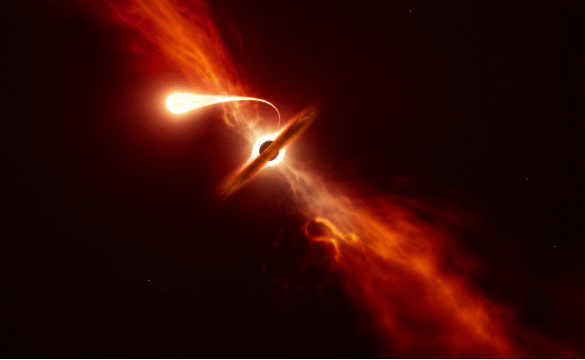
A depiction of what a Tidal Disruption Event would look like.
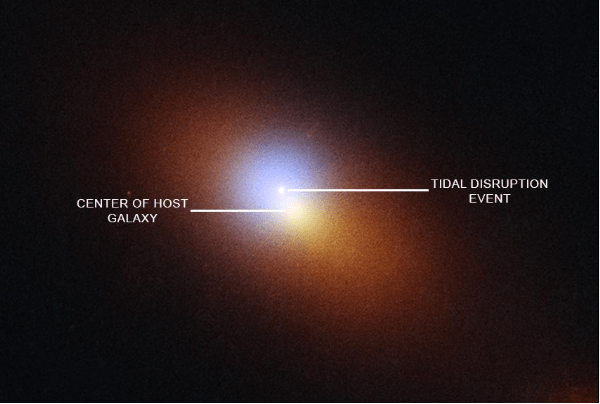
A real image of a TDE taken by a NASA telescope
 thethinkingatom
Leave a Reply